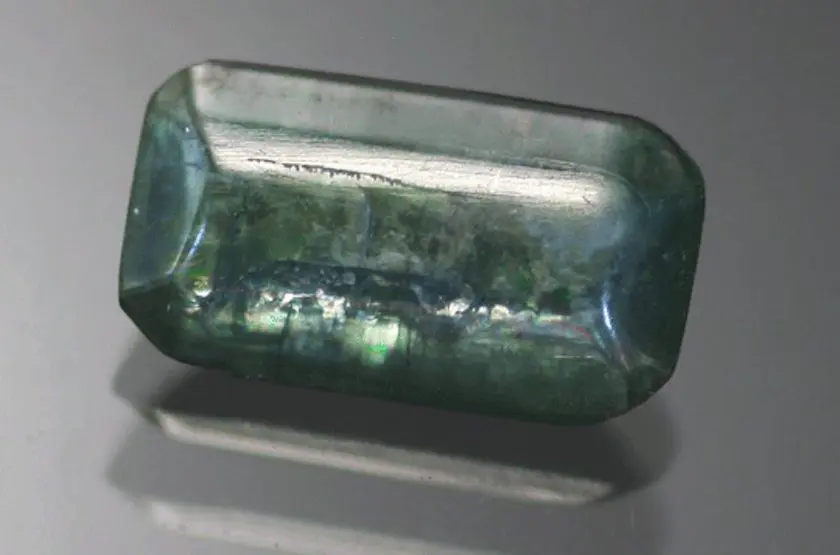
Vivianite
Vivianite is so fragile and soft, any faceted gems would be difficult to handle safely, let alone wear. Nevertheless, its blue and green colors are so rich, a few stones (very few) have been cut. Vivianites make beautiful collector’s gemstones.
About
Vivianite
Does Vivianite Make a Good Jewelry Stone? In an interview, rare-gem faceter and supplier C. D. Parsons acknowledges looking forward to cutting vivianite someday, something very few have done. With a hardness between talc and gypsum (1.5-2) and perfect cleavage, few could manage this feat. Thin pieces are even flexible and sectile (cuttable with a knife). Due to their fragility, vivianites would not make good jewelry stones. However, this gem material can show beautiful dark shades of blue and green. It also displays intense pleochroism. Depending on the viewing angle, stones can reveal up to three colors, including yellowish green and olive-green, blue-green, and indigo. When mined, vivianites are colorless or pale green, but their colors darken after exposure to light. As a result, an enthusiast may find an attractive color disappearing over time. Not surprisingly, this further de-incentivizes cutting an already challenging stone. Still, the appeal remains. You’re more likely to find vivianites in mineral collections than jewelry collections. vivianite – Huanuni Mine Vivianite crystal, Huanuni Mine, Huanuni, Dalence Province, Oruro Department, Bolivia. Photo by Géry Parent. Licensed under CC By-SA 3.0. Is There Vivianite in Odontolite? In the past, vivianite was believed to be the cause of the blue color of so-called odontolite. This fossilized bone and teeth material may resemble turquoise. (It’s also called “bone turquoise”). However, heat treatments have been shown to produce the color artificially. Identifying Vivianite Like its coloration, vivianite’s streak starts colorless but becomes dark blue over time. Please note: don’t conduct streak testing on finished gems. Test material in inconspicuous spots as a last resort only. Bolivian material has the following properties. Refractive indices (RI): 1.585, 1.603, and 1.639. Specific gravity (SG): 2.64. Are There Synthetic Vivianites? Scientists have synthesized vivianite for a variety of purposes, including environmental and agricultural research. However, there’s no known jewelry use for this lab-created material. There are no known gemstone treatments or enhancements. Where are Vivianites Found? The following sources yield good-quality gem material: Bolivia, Llallagua and Poopo: fine, cuttable crystals to 6 inches long. Cameroon, N’gaoundere: massive crystals up to 4 feet long, dark in color, cuttable. United States: Lemhi County, Idaho, fine crystals; Richmond, Virginia, good crystals; Bingham Canyon, Utah, crystals to 5 inches in length. Other notable sources include the following: United States: California; Colorado; Delaware; Florida; Maryland; New Jersey; Black Hills, South Dakota (in pegmatites). Australia; Canada; England; France; Germany; Japan; Russia. vivianite – Germany An unusual specimen of radiating, intergrown blade-shaped vivianites. Hesse, Germany. © Rob Lavinsky, www.iRocks.com. Used with permission. Stone Sizes Gem cutters rarely facet vivianites, and their almost micaceous cleavage makes polishing gems very difficult. For example, the Bolivian material could yield cut stones up to 75-100 carats. However, this just doesn’t occur. Caring for Vivianites Store your vivianite specimens out of the light to protect their color. Consult our gemstone jewelry cleaning guide for more recommendations.
Physical & Chemical Properties
| Name | Vivianite |
|---|---|
| Scientific Name | hydrated iron(II) phosphate mineral |
| Mineral Group | Monoclinic. Crystals prismatic, tabular, equant; in clusters, radial groups. Also massive, bladed, fibrous; crusts, earthy masses. |
| Hardness (Mohs) | 1.5-2 |
| Color | darkens to shades of green and blue, then dark green, dark bluish green, dark purplish, blueish black |
| Origin | United States: Lemhi County ,Bolivia, Llallagua and Poopo |
| Chemical Formula | Fe3(PO4)2 · 8H2O. |
Quick Facts
| Crystal System | Monoclinic |
|---|---|
| Specific Gravity | 2.64-2.68 |
| Birthstone | St Agnes, Cornwall, England |
| Refractive Index | 1.569 and 1.675 |
| Optical Character | Biaxial + |
| Dispersion | Weak |
| Major Sources | United States: California; Colorado; Delaware; Florida; Maryland; New Jersey; Black Hills, South Dakota (in pegmatites). Australia; Canada; England; France; Germany; Japan; Russia. |
| Treatments | Vivianite treatments in industrial wastewater management focus on managing, removing, or recovering iron phosphate ( ) that precipitates in anaerobic digesters, pipes, and centrifuges. Techniques include acid cleaning (hydrochloric acid), mechanical removal (hydro-jetting), and modern magnetic separation to recover phosphorus and iron for sustainable fertilizer/battery industry use. |
| Common Enhancements | Vivianite, a rare hydrated iron phosphate mineral ( ), is known for its dramatic color changes from colorless or pale green to deep blue or black upon exposure to light and oxygen. Because of its high sensitivity, "enhancements" for this mineral usually refer to environmental preservation techniques to maintain its color, or, in scientific contexts, treatments to increase its reactivity and stability as a phosphorus fertilizer or for industrial phosphorus recovery. |
| Price Range | $5 - $100 |
| Care Instructions | Store your vivianite specimens out of the light to protect their color. Consult our gemstone jewelry cleaning guide for more recommendations. |