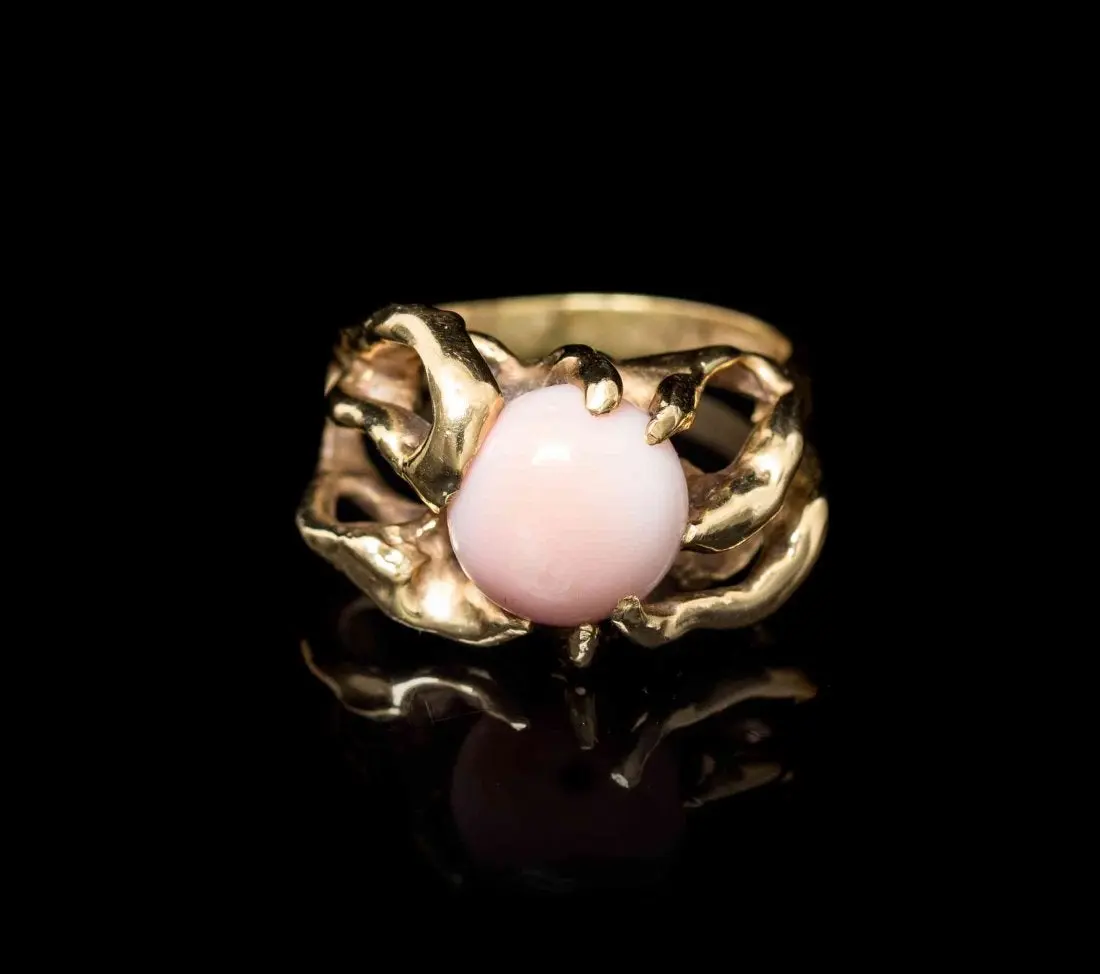
Calcareous Concretions
Calcareous concretions are rounded, compact masses primarily composed of calcium carbonate that form within sedimentary rocks. They are created through mineral precipitation around a nucleus, such as a fossil or organic material. These formations are valued more as geological specimens than traditional gemstones but are sometimes polished for decorative or collector purposes.
About
Calcareous Concretions
Calcareous concretions are fascinating geological formations composed mainly of calcium carbonate (CaCO₃). Unlike traditional minerals, they are not a single crystal but rather a compact aggregation of minerals that form through sedimentary processes. These concretions develop when mineral-rich groundwater precipitates calcium carbonate around a central nucleus, which could be a fossil, shell fragment, or organic matter. The formation process typically occurs in sedimentary environments such as limestone, shale, or sandstone deposits. Over time, as water flows through the sediment, dissolved minerals begin to accumulate around the nucleus, gradually forming a dense, spherical or irregular mass. This process can take thousands to millions of years, resulting in well-defined structures that often stand out from the surrounding rock.
Physical & Chemical Properties
| Name | Calcareous Concretions |
|---|---|
| Scientific Name | Calcareous Concretions |
| Mineral Group | Carbonate |
| Hardness (Mohs) | 3 – 4 |
| Color | White, gray, brown, yellow, reddish |
| Origin | USA, United Kingdom, Canada, Germany, India |
| Chemical Formula | CaCO₃ |
Quick Facts
| Crystal System | Trigonal (calcite component) |
|---|---|
| Specific Gravity | 2.6 – 2.8 |
| Birthstone | NA |
| Refractive Index | 1.49 – 1.66 |
| Optical Character | Uniaxial (calcite-based) |
| Dispersion | Low |
| Major Sources | USA, United Kingdom, Canada, Germany, India |
| Treatments | Usually untreated |
| Price Range | $5 - $10 |
| Care Instructions | Avoid acids (reacts with calcium carbonate) Handle gently (soft material) Clean with dry or slightly damp cloth |