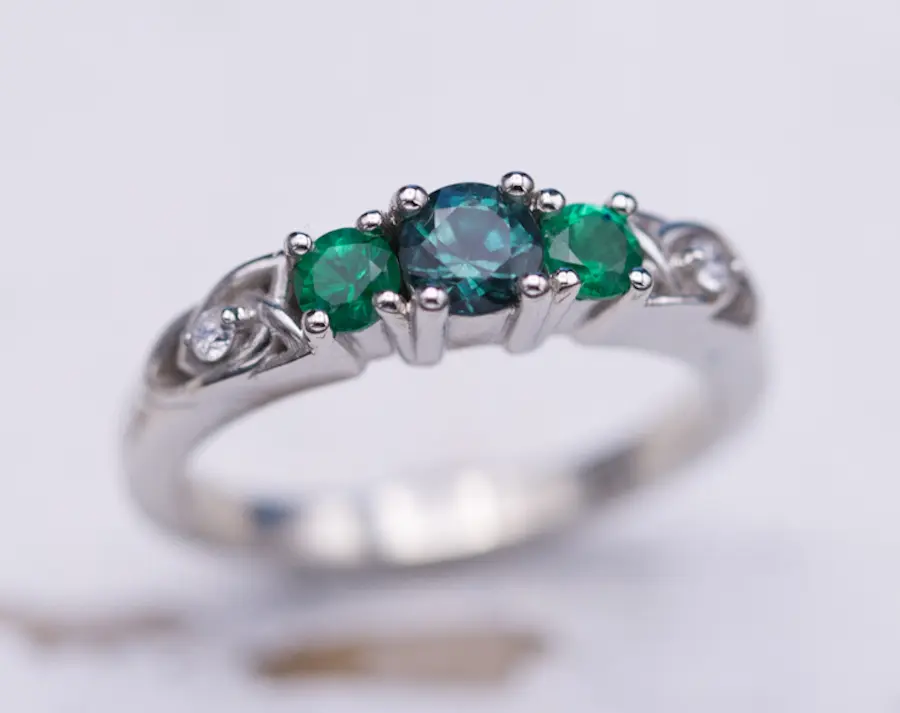
Alexandrite
Alexandrite is a rare and valuable gemstone famous for its remarkable color-changing ability, shifting from green in daylight to red or purplish-red under incandescent light.
About
Alexandrite
Alexandrite is a rare and fascinating gemstone from the chrysoberyl family, known for its unique color-change effect. In daylight, it appears green to bluish-green, while under warm light it changes to red or purplish-red, often described as “emerald by day, ruby by night.” This effect is caused by the presence of chromium in its structure. It was first discovered in Russia’s Ural Mountains and named after Tsar Alexander II. Alexandrite forms under rare geological conditions, making it highly valuable and scarce. It has a hardness of 8.5, making it suitable for everyday jewelry. The gemstone also shows pleochroism, displaying different colors from different angles. Overall, Alexandrite is prized for its rarity, beauty, and association with balance and transformation.
Physical & Chemical Properties
| Name | Alexandrite |
|---|---|
| Scientific Name | Alexandrite (Variety of Chrysoberyl) |
| Mineral Group | Chrysoberyl (Oxide Mineral) |
| Hardness (Mohs) | 8.5 |
| Color | Green to bluish-green (daylight), red to purplish-red (incandescent light) |
| Origin | Russia, Brazil, Sri Lanka, India, Tanzania, Madagascar |
| Chemical Formula | BeAl₂O₄ |
Quick Facts
| Crystal System | Orthorhombic |
|---|---|
| Specific Gravity | 3.5 – 3.8 |
| Birthstone | June |
| Refractive Index | 1.74 – 1.76 |
| Optical Character | Biaxial (+) |
| Dispersion | Low (but strong color-change effect) |
| Major Sources | Russia (Ural Mountains), Brazil, Sri Lanka, India, Tanzania, Madagascar |
| Treatments | Usually untreated (natural stones are highly valued) |
| Price Range | $5,000 – $70,000 |
| Care Instructions | Clean with mild soap and water. Ultrasonic cleaners are generally safe but use caution. Store separately to avoid scratches. |